
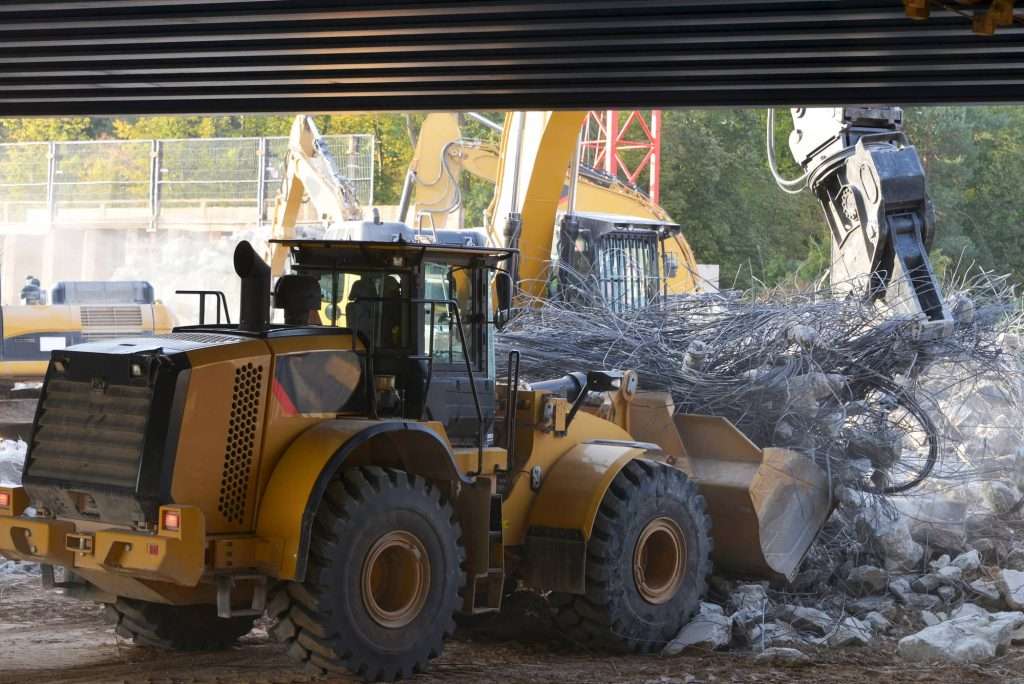
The success of your commercial building demolition project depends on your planning and execution. We’re going to answer two questions often asked in the planning stage. What are the types of commercial building demolition? And what factors affect the cost of commercial building demolition?
Here’s everything you need to know.
4 Different Types Of Commercial Demolition
There are four different types of commercial builing demolition:
- Total Demolition: The complete removal of a building.
- Selective Demolition: Only a part of the building is removed.
- Deconstruction: Involves dismantling the building in a way that preserves the removed parts for future reuse.
- Interior Demolition: The building’s interior structure is removed while leaving the exterior in place.
What Affects The Cost Of Commercial Building Demolition?
There are plenty of factors that influence the cost of commercial building demolition. We discuss the most relevant factors below.
Permits
Before starting a commercial demolition project, the first thing you must do is apply for a demolition permit with your local authorities.
You should note that if you plan to demolish more than one building, you’ll need a permit for each building.
To obtain your demolition permit you need the following
- A completed permit application form
- An approved grading plan (Check with your local authorities if this is a requirement)
- An inspected and complete plumbing permit
- Cash demolition escrow bond (A refundable payment that’s used as a guarantee you’ll ensure the safe, secure, and sanitary execution of your demolition project)
- Proof you’ve disconnected utilities
To save time, ask your general contractor or demolition expert to help you out with the demolition permits.
Hazardous Material
When applying for your demolition permit, you must submit a report on hazardous materials. Thus, you’ll need to hire an inspector to look for toxic materials like asbestos, chlorofluorocarbons (CFCs), polychlorinated biphenyls (PCBs), and heavy metal (commonly found in lead-based paint).
The EPA has demolition regulations that require special handling when removing, transporting, and disposing of toxic materials. So, the cost of your demolition project will increase if there are any hazardous materials found.
You should also note that the soil around your building might contain hazardous materials. If this is the case, you must arrange for the removal of this soil before construction begins.
Site Evaluation
Before ‘bulldozing’ your way into the building marked for demolition, conduct a site evaluation first. A site evaluation is important because:
- It’ll help you gather information about the condition of the building.
- It’ll help you identify environmental issues if any that might affect the demolition process.
- The information gathered will help you determine the demolition method to use.
- It’ll help you set up the necessary safety precautions when you’ve identified the risks the demolition crew is likely to face.
Additionally, a site evaluation doesn’t only affect the success of your demolition project, it also affects the success of your construction project. This is especially important if you’re planning to use part of the existing building’s foundation to build your new building.
Safety
Unfortunately, accidents can happen on a demolition site. Therefore, for your safety and peace of mind, you must ensure your demolition expert puts up all the required safety precautions before and during demolition.
These safety precautions are there to ensure the health and wellbeing of the demolition crew and the general public are well protected.
Some of the safety measures for demolition sites include:
- Conducting a hazardous material inspection
- Ensuring the demolition crew wears personal protective equipment (PPE)
- Maintaining a clean site
- Hiring a demolition expert who uses a trained and experienced demolition crew
- Managing traffic movement
- Conducting risk assessments
- Proper disposal of waste
Remember, aside from these safety tips, you must also keep up with the safety standards set up by OSHA.
Recycling / Repurposing Materials
The first thing you think of when you hear the word ‘demolition’ is ‘destroy.’ However, on a demolition site, not everything gets destroyed. There’s plenty of salvageable material you can repurpose or recycle on a demolition site.
Some of the most common salvageable materials include wood, glass, metals, drywall, concrete, doors, interior finishes, light fixtures, etc.
Ask your contractor what can be reused or recycled, whether somewhere else or for the building project set to take place on the site after the demolition is complete. This can help you reduce costs for your build.
Apart from reducing the cost of your project, recycling or repurposing these materials has a positive impact on the environment and economy:
- It creates new job opportunities for your community
- Helps conserve natural resources like minerals, forests, and water
- Reduces the use of incinerators and landfills
Conclusion
Each demolition project is unique. Therefore, when hiring a local general contractor to handle your demolition, make sure you enquire about their experience handling a project similar to yours. Also, be sure to ask about their prices.
With the information we’ve provided in this article, you’ll be able to better understand the costs of your demolition project.